Introduction
Airlines are often compared through routes, schedules, fares and cabin products. These factors remain fundamental, but they do not fully explain how customers experience a premium airline. The journey begins while a customer searches, books and prepares to travel; it continues through the airport, lounge and flight; and it can extend into membership, rewards and lifestyle services after arrival.
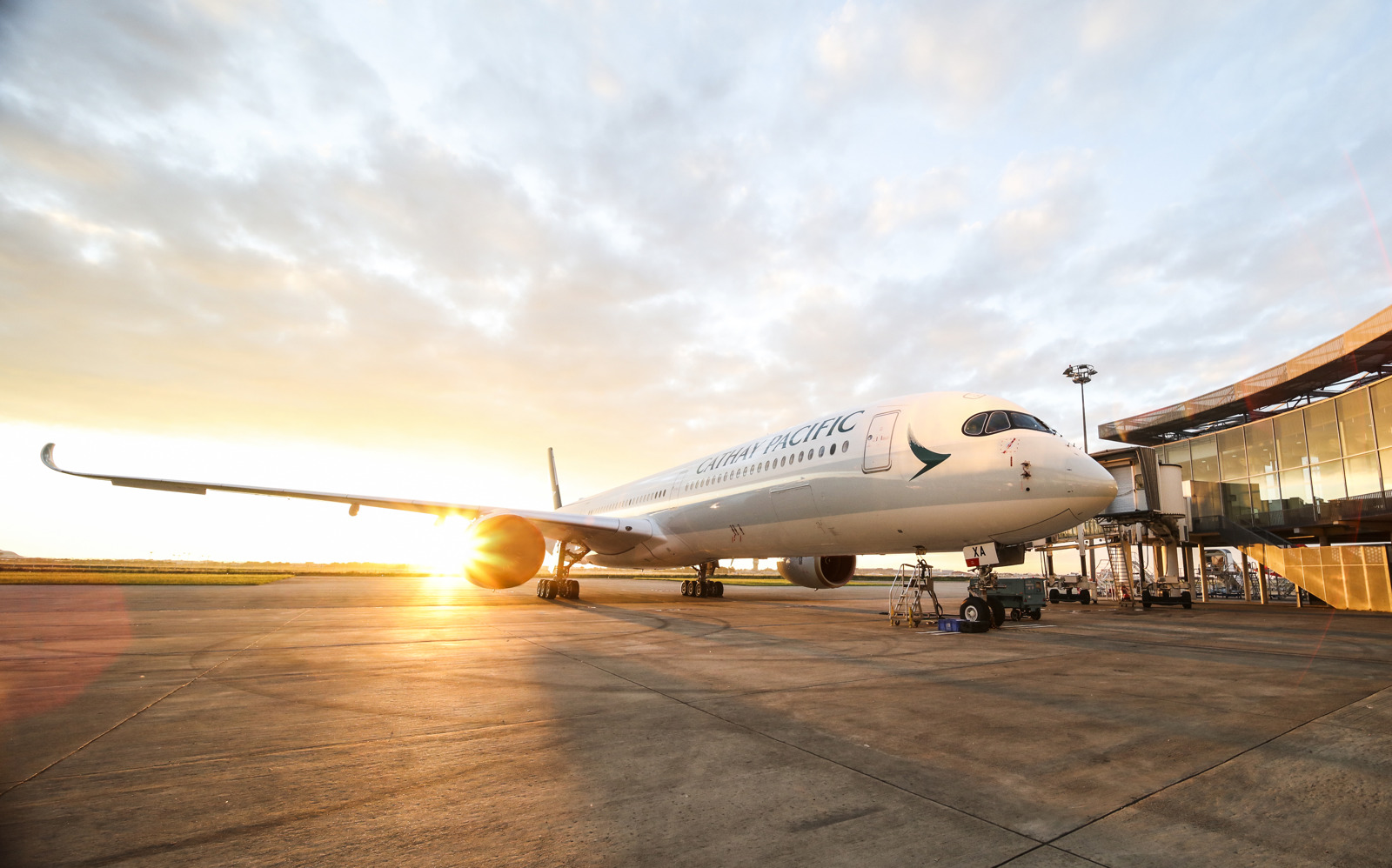
Cathay Pacific has developed its brand around this wider journey. Its Hong Kong identity appears in lounge design, dining and service; its cabin products combine physical comfort with a restrained visual language; its partnerships add materials and amenities; and its membership programme connects flying with travel and everyday spending.
This research argues that Cathay’s differentiation depends on the coordination of these elements. Individual features can be copied. A consistently managed journey across multiple touchpoints is harder to reproduce because it requires shared standards, operational alignment and continued investment.
Business and financial context
The Cathay Group reported revenue of approximately HK$116.8 billion and attributable profit of HK$10.8 billion for 2025. Attributable profit increased from HK$9.9 billion in 2024. The company attributed the result to increased capacity, solid passenger load factors and resilient cargo demand, partly offset by passenger-yield normalisation and losses at HK Express. [1] [2]
The operating recovery gives Cathay greater capacity to invest in aircraft, cabins, lounges and digital services. The group has committed more than HK$100 billion to fleet, cabin and lounge products, and digital innovation. [2]
External recognition provides additional evidence of customer-facing progress. In the 2025 Skytrax World Airline Awards, Cathay Pacific was ranked among the world’s top three airlines and received awards for World’s Best Economy Class and World’s Best Inflight Entertainment. These rankings indicate market recognition, but they do not establish that brand integration alone caused the company’s financial recovery. [3]
How Cathay connects the customer journey
Cabin design: comfort, privacy and control
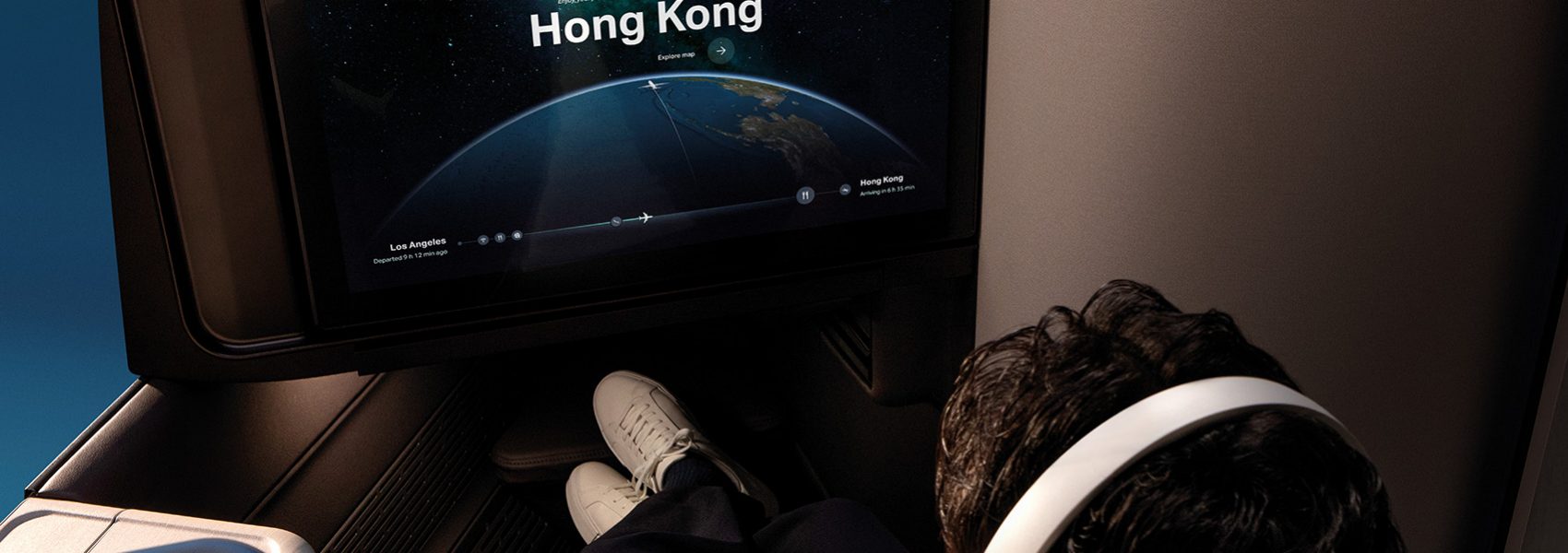
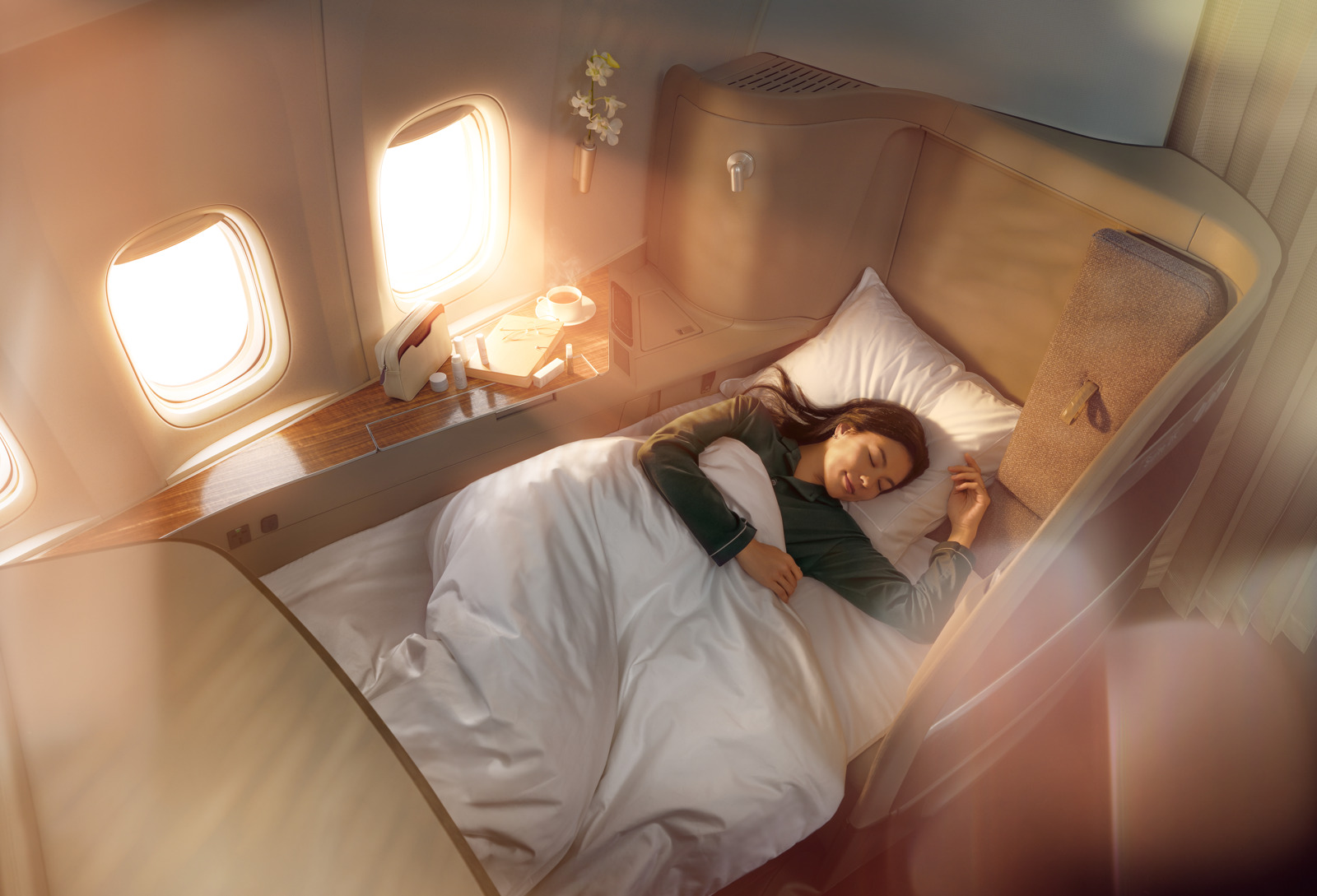
Cathay’s Aria Suite illustrates how product design can express the wider brand. Introduced on retrofitted Boeing 777-300ER aircraft, the business-class product combines privacy doors, lighting controls, storage and connectivity within a human-centred cabin design. The important point is not that each feature is unique. It is that the suite translates the brand’s emphasis on calm, intuitive and considered service into the physical cabin. [4]
Lounges: extending the brand on the ground
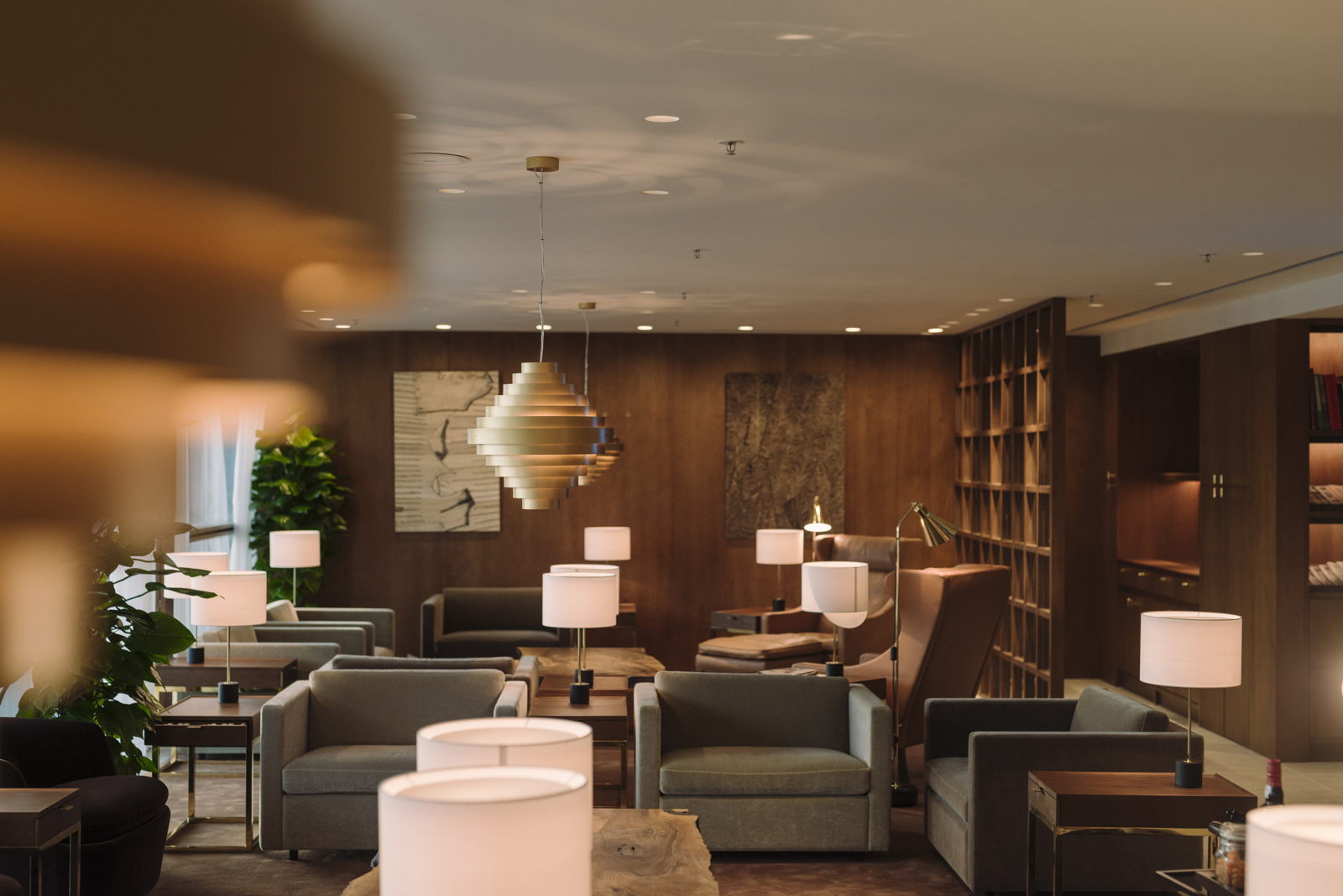
Cathay’s lounges extend the experience beyond the aircraft. The Pier, Business at Hong Kong International Airport combines functional facilities with spaces such as the Noodle Bar and Teahouse. Local food and a more residential atmosphere connect the lounge to Hong Kong while giving eligible customers a place to work, eat or rest before departure. [5]
The lounge therefore performs two roles. Operationally, it makes waiting more comfortable. Strategically, it allows Cathay to deliver its hospitality and design language before boarding, when the airline has greater control over the environment than it does elsewhere in the airport.
Sensory identity: materials, sound and memory
Premium service is experienced through more than visual design. Bedding, amenity materials, food, lighting and sound can influence how customers interpret comfort and quality. Research on sensory marketing suggests that sensory inputs can affect perception, judgement and behaviour, although their effect varies by context and customer. [6]
Cathay’s partnership with Bamford adds bedding, amenity kits and skincare products to selected premium cabins. These elements translate the brand into touch, scent and physical comfort. [7] Its sonic identity, Song of Cathay, performs a different function: it provides a recurring audio cue intended to make the brand recognisable across settings. [8]

These initiatives should not be treated as proof that sensory branding produces loyalty by itself. Their strategic role is to reinforce a broader service system in which multiple cues communicate a similar idea of the brand.
Membership: continuing the relationship after the flight
Cathay membership and Asia Miles extend the customer relationship beyond a single journey. Members can earn and redeem miles through flights and a network of more than 800 travel and lifestyle partners spanning areas such as hotels, shopping, dining and wellness. [9]
This wider network makes the programme relevant between flights. It also gives Cathay more opportunities to remain present in customers’ travel planning and everyday spending. The commercial value is not limited to points: membership can connect recognition, benefits, partner activity and future bookings within one customer relationship.
How the system creates competitive advantage
From copyable features to coordinated differentiation
An airline can purchase a new seat, commission a lounge or form an amenity partnership. Competitors can respond with comparable individual features. Cathay’s more defensible advantage arises when cabin products, ground hospitality, digital services, sensory cues and membership reinforce one another.
The causal logic is straightforward:
- 1
Individual touchpoints deliver functional and emotional value.
- 2
Shared design and service standards make those touchpoints feel related.
- 3
Repetition across the journey strengthens recognition and customer expectations.
- 4
Membership and rewards extend the relationship beyond the flight.
- 5
Coordinating the full system requires capabilities that are slower to copy than an isolated product.
This reflects a differentiation strategy: the company seeks to create value through a distinctive configuration of activities rather than by competing only on price. Porter’s framework also emphasises that advantage can arise from the way activities fit together, not simply from the quality of each activity in isolation. [10]
Loyalty and switching costs
The membership system can add practical reasons to remain with Cathay. Status benefits, accumulated Asia Miles and familiarity with the service reduce the need to rebuild the same relationship elsewhere. These are not absolute barriers: customers can still choose another airline based on schedule, route or fare. However, the value accumulated across membership and partner activity can influence the decision when competing offers are otherwise similar.
The result is a layered form of differentiation. Product quality helps Cathay enter the customer’s consideration set; a coherent journey makes the brand more memorable; and membership gives the relationship continuity. None of these elements is sufficient alone, but their combination can be more durable than a single award-winning feature.
Risks
01 — Premium demand and yield normalisation
Premium positioning depends on customers remaining willing to pay for differentiated service. Economic weakness, corporate travel changes or increased price sensitivity could reduce premium demand. Cathay’s 2025 results already show that passenger-yield normalisation can offset some of the benefits of capacity growth and strong load factors. [2]
02 — Inconsistent execution across touchpoints
An integrated journey creates value only when operational delivery matches the brand promise. Service inconsistency, lounge congestion, ageing products or digital friction can be more damaging when customers expect a coordinated premium experience. The wider the system becomes, the more functions and partners Cathay must align.
03 — Regional competition
Asian and Middle Eastern airlines continue to invest in cabins, lounges, dining and loyalty. Competitors may not need to copy Cathay’s entire model; they can weaken its differentiation by matching the touchpoints customers value most on important routes.
04 — Hub and geopolitical exposure
Cathay’s Hong Kong identity is an advantage, but the company is also highly exposed to the performance of its home hub. Geopolitical tension, travel restrictions, airspace disruption and changes in traffic flows could affect demand or network economics. The brand system cannot remove these structural aviation risks.
Limitations
This analysis relies primarily on Cathay’s financial disclosures, product information and brand communications, supplemented by established strategy and consumer-research frameworks. Company materials are useful for identifying investments and intended positioning, but they may present the customer experience more favourably than independent observation would.
The research explains the strategic logic connecting product, hospitality, sensory identity and loyalty. It does not prove that every passenger experiences the journey consistently, that all initiatives generate an economic return, or that brand integration caused Cathay’s financial performance. Stronger causal conclusions would require customer-level retention data, route-level yield analysis, independent service audits and comparisons with competing airlines.
Insights
01 — Design the journey, not only the product
Customers evaluate a service through a sequence of interactions. Improving one flagship feature may not compensate for friction elsewhere. Businesses should identify the moments that shape expectations, delivery and memory, then design the transitions between them.
02 — Use sensory cues with a clear role
Sound, materials, lighting, scent and food can make a service more recognisable, but only when they support a coherent brand idea. Sensory details should clarify the experience rather than operate as decoration.
03 — Consistency is more defensible than isolated luxury
Competitors can often buy similar physical features. It is harder to reproduce a system in which teams, partners and operating standards deliver a consistent idea across many touchpoints.
04 — Combine emotional and functional value
Premium value is not purely symbolic. Privacy, rest, efficient service and useful rewards provide functional benefits; design, hospitality and identity add emotional meaning. The strongest positioning connects both.
Conclusion
Cathay Pacific has extended its premium brand beyond the aircraft by coordinating cabin design, lounges, hospitality, sensory identity and membership across a wider customer journey. Aria Suite, The Pier, Bamford amenities, Song of Cathay and Asia Miles are not separate proofs of advantage. They are components of a system intended to express a consistent promise at different moments.
The strategic advantage lies in integration. Individual airline products can be imitated, but coordinating physical environments, service behaviour, brand cues and loyalty relationships requires continued investment and organisational alignment. If Cathay can deliver that system consistently while managing demand, competition and hub exposure, it can compete not only as a carrier, but as a premium travel and lifestyle brand.
Revision history
Editorial revision
Repeated explanations of the premium ecosystem were consolidated. Business context, implementation, competitive effects, risks and limitations were separated more clearly. The research question and central conclusion were retained.
- Research question
- Retained
- Conclusion
- Retained
- Material change
- No
References
- [1]
Cathay Pacific Airways Limited (2026). Annual Report 2025. Investor Relations. https://www.cathaypacific.com/cx/en_US/investor-relations/interim-annual-reports.html (accessed 23 August 2026).
- [2]
Cathay Pacific Airways Limited (2026). The Cathay Group announces 2025 Annual Results. https://news.cathaypacific.com/the-cathay-group-announces-2025-annual-results (accessed 23 August 2026).
- [3]
Cathay Pacific Airways Limited (2025). Cathay Pacific named among the world’s top three best airlines, and wins World’s Best Economy Class and Inflight Entertainment in annual Skytrax awards. https://news.cathaypacific.com/cathay-pacific-named-among-the-world-s-top-three-best-airlines-and-wins-world-s-best-economy-class-and-inflight-entertainment-in-annual-skytrax-awards-u9wn4o (accessed 23 August 2026).
- [4]
Cathay Pacific Airways Limited (2024). Cathay Pacific unveils Aria Suite, a new way to experience air travel. https://news.cathaypacific.com/cathay-pacific-unveils-aria-suite-a-new-way-to-experience-air-travel-wgs4bx (accessed 23 August 2026).
- [5]
Cathay Pacific Airways Limited (n.d.). The Pier, Business — Hong Kong. https://www.cathaypacific.com/cx/en_AU/destinations/lounges/hong-kong-hkg/the-pier.html (accessed 23 August 2026).
- [6]
Krishna, A. (2012). “An integrative review of sensory marketing: Engaging the senses to affect perception, judgment and behavior.” Journal of Consumer Psychology, 22(3), 332–351. https://doi.org/10.1016/j.jcps.2011.08.003 (accessed 23 August 2026).
- [7]
Cathay Pacific Airways Limited (2019). A Sense of Harmony. https://news.cathaypacific.com/a-sense-of-harmony-288510 (accessed 23 August 2026).
- [8]
Cathay Pacific Airways Limited (2024). Cathay unveils “Song of Cathay”, its new sonic branding. https://news.cathaypacific.com/cathay-unveils-song-of-cathay-its-new-sonic-branding-that-captures-the-love-for-travel-and-aviation-1hd6yp (accessed 23 August 2026).
- [9]
Cathay Pacific Airways Limited (n.d.). Membership and Asia Miles. https://www.cathaypacific.com/cx/en_ID/membership.html and https://www.cathaypacific.com/cx/en_BH/membership/asia-miles.html (accessed 23 August 2026).
- [10]
Porter, M. E. (1985). Competitive Advantage: Creating and Sustaining Superior Performance. New York: Free Press. https://www.hbs.edu/faculty/Pages/item.aspx?num=193 (accessed 23 August 2026).