Introduction
Luxury demand often creates pressure to expand output. If a product can be sold at a high margin, producing more appears to be the direct path to growth. Hermès follows a more constrained model. The company increases capacity, but it does so gradually and within an operating system built around craftsmanship, material selection, training, in-house production and an exclusive distribution network.
This does not mean that Hermès refuses to grow. In 2025, the company increased revenue, invested in capacity and opened its twenty-fourth leather-goods workshop. The distinction is that production capacity is expanded through additional craft capability rather than by treating demand as the sole determinant of output. [1]
This research argues that supply discipline contributes to Hermès’ competitive advantage through a clear sequence: quality standards limit how quickly production can expand; constrained and selective availability protects exclusivity; exclusivity supports customers’ willingness to pay; and the craft, supplier, training and distribution capabilities behind the system are difficult to reproduce quickly.
Business and financial context
Hermès generated €16.0 billion in revenue in 2025, an increase of 8.9% at constant exchange rates and 5.5% at current exchange rates. Recurring operating income reached €6.57 billion, equal to 41% of revenue. Leather Goods and Saddlery, the company’s largest business line, generated €7.07 billion and grew 13.1% at constant exchange rates. [1]
The company also invested €1.16 billion in operations during the year. It opened its twenty-fourth leather-goods workshop in L’Isle-d’Espagnac and reported further planned workshops in Loupes, Charleville-Mézières and Colombelles. Hermès therefore combines controlled supply with continued capacity expansion; the model is disciplined growth, not permanent production stagnation. [1]
These results are consistent with the argument that exclusivity and growth can coexist. They do not prove that supply discipline alone caused Hermès’ performance. Brand heritage, creative direction, product desirability, geographic expansion, customer loyalty and market conditions also contribute.
The logic of supply discipline
Definition
Supply discipline is the practice of expanding production only when the organisation can preserve its required standards of craftsmanship, materials and quality. Under this model, demand influences investment decisions, but it does not automatically determine immediate output.
The concept differs from simply withholding finished products. A company could restrict availability through a marketing decision without changing how products are made. Hermès’ model is more deeply embedded: the pace of growth is linked to the availability of trained craftspeople, suitable materials, workshop capacity, quality control and a distribution network the company can supervise.
Why not maximise short-term volume?
Increasing volume faster could generate additional sales, but it could also weaken the conditions that support long-term value. Rapid expansion may create pressure to simplify production, accept wider material variation, shorten training, outsource critical work or increase distribution faster than service standards can be maintained.
Hermès therefore treats production constraints as strategic boundaries. The company does expand, but the relevant question is not simply “How much can the market absorb?” It is “How much can the organisation produce without weakening the qualities for which customers pay?”
Scarcity as an outcome of the system
The scarcity associated with Hermès should not be understood as entirely natural or entirely manufactured. Management chooses how quickly to invest, which products to make, how to allocate them and where to sell them. At the same time, skilled craft production and material standards impose real limits on the speed at which supply can grow.
The analysis therefore interprets Hermès’ scarcity as credible scarcity: availability is restricted partly by deliberate strategic choices and partly by the genuine difficulty of scaling the production system while maintaining quality.
How Hermès operates the supply system
Craft capability
Leather-goods production depends on skilled manual work, repeated practice and detailed quality control. Design, material preparation, cutting, assembly, stitching, edge treatment and finishing require judgement that cannot be expanded as quickly as standardised mass production.
Hermès supports this capability through its École Hermès des savoir-faire and a wider training infrastructure. In 2025, the company reported twelve training facilities. The official materials confirm formal investment in craft education, but they do not establish one universal training period for every role or product. For that reason, this analysis does not use an exact number of months or years as a group-wide rule. [1] [2]

Materials and supplier relationships
Quality depends on inputs as well as labour. Leather, silk, precious materials, hardware and other components must meet standards for appearance, durability and workability. Greater output can therefore create pressure not only on workshops, but also on the suppliers and processes that support them.
Hermès describes a highly integrated model and long-term supplier relationships. In 2025, 55% of products were manufactured in in-house and exclusive workshops, 75% of objects were made in France, and all leather goods were made in France. These figures do not mean that Hermès controls every input, but they show a substantial commitment to production oversight and local craft capacity. [1] [3] [6]
Vertical integration and quality control
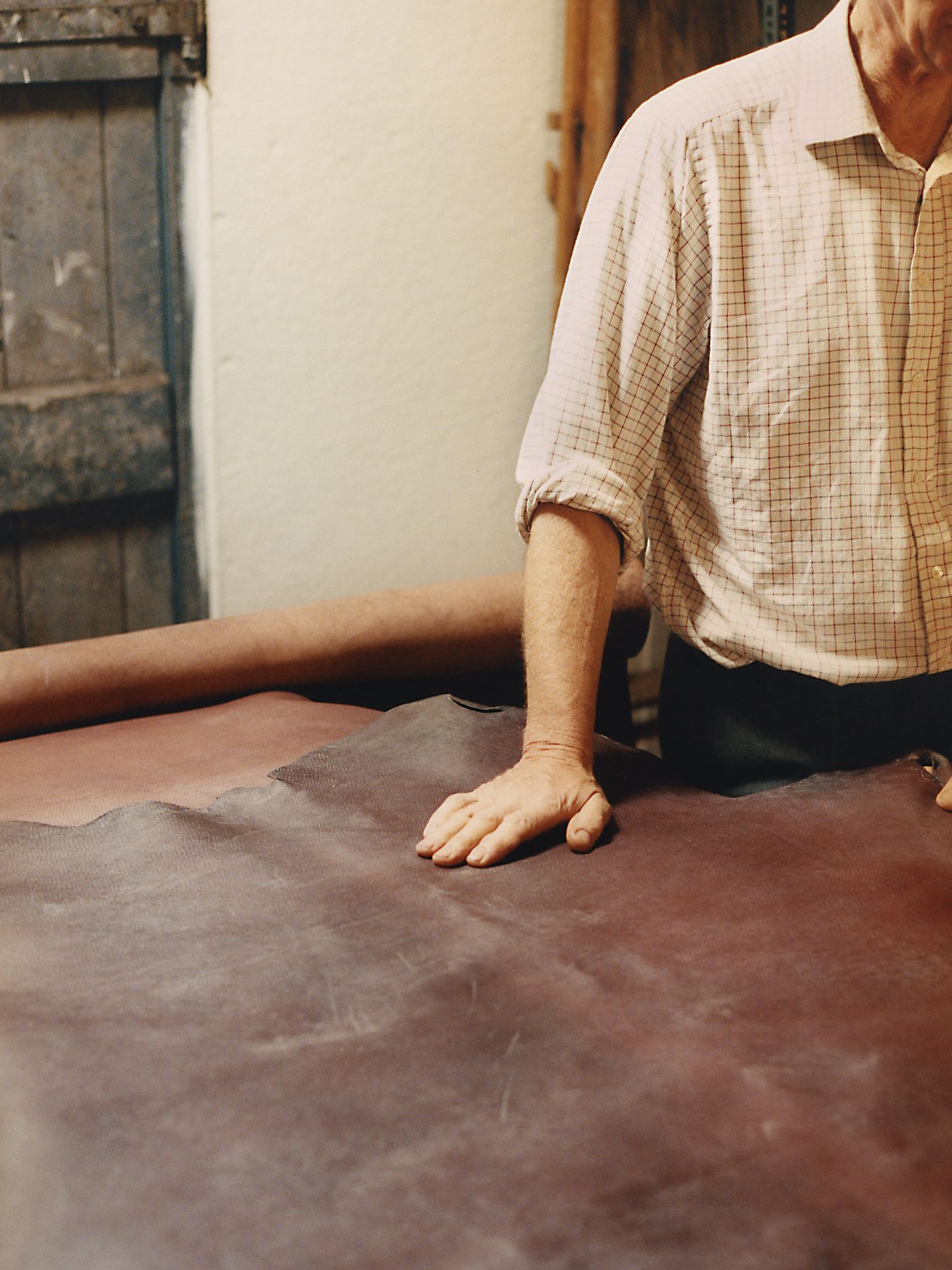
Vertical integration gives Hermès greater control over knowledge, process and standards. In-house and exclusive workshops allow the company to retain critical skills, transmit production methods and monitor quality more directly than a model based primarily on arm’s-length outsourcing.
This control also improves coordination between design and production. Products can be developed with a clearer understanding of material behaviour and craft requirements. The result is not complete independence from external partners, but a tighter relationship between creative intent and manufacturing capability.
Gradual capacity expansion
Hermès increases supply by adding workshops, training craftspeople and developing local production clusters. In 2025, it opened its twenty-fourth leather-goods workshop and set out a multi-year schedule for additional sites. This is a meaningful form of expansion, but it is slower and more capability-intensive than increasing orders from a contract manufacturer. [1]

Gradual expansion serves two purposes. It allows Hermès to capture growth over time, and it reduces the risk that immediate demand will force production beyond the organisation’s ability to preserve standards.
Distribution discipline
Hermès pairs production control with what it calls an “exclusive and qualitative” distribution network. The company expands this network through selected openings, renovations and extensions rather than relying on broad wholesale availability. [1]
Selective distribution gives Hermès greater control over presentation, service and inventory. Stores do more than complete transactions: they communicate the house’s visual language, introduce customers to multiple métiers and allow local teams to manage relationships and product availability.
This control also contributes to scarcity. Limited production combined with selective points of sale means that demand for some products can exceed availability in particular markets. However, public information does not provide a complete view of store-level allocation decisions, wait times or customer selection. Claims about these mechanisms should therefore remain cautious.
How the system creates competitive advantage
Pricing power
When products are desirable and availability is limited, customers may become less price-sensitive. Hermès’ quality, design, heritage and scarcity can therefore support premium pricing. Supply discipline contributes by reducing the risk that excessive availability makes the products feel ordinary.
Pricing power should not be attributed to scarcity alone. Scarcity without product desirability can produce unsold inventory rather than a premium. Hermès’ advantage depends on the interaction between creative demand and controlled supply.
Exclusivity without constant visibility
Luxury products derive part of their value from distinction. If distribution expands too widely or production rises too quickly, visibility can increase while exclusivity declines. Hermès’ system protects a degree of rarity by allowing capacity to grow more slowly than short-term demand might permit.
This reflects differentiation strategy: the company competes through qualities customers perceive as distinctive rather than by pursuing the lowest cost or broadest volume. [4]
Long-term brand equity
Supply discipline also protects the future meaning of the brand. Decisions that maximise current sales may reduce the perceived rarity, quality or integrity of products later. By accepting some short-term constraint, Hermès can preserve the expectations attached to its name and support demand across generations of products.
The relationship is cumulative. Each product that meets expectations reinforces trust in the house; each workshop that transmits its methods preserves production knowledge; and each controlled retail environment reinforces the way products are presented. The value emerges over time rather than from a single launch.
A system that is difficult to imitate
Competitors can copy visible elements of a luxury product more easily than they can reproduce the organisation behind it. Hermès’ advantage combines tacit craft knowledge, training systems, supplier relationships, workshop routines, quality control, design capabilities, brand heritage and distribution.
From a resource-based perspective, a capability is more likely to support sustained advantage when it is valuable, difficult to imitate and not easily replaced by an equivalent system. Hermès’ individual resources are not all unique, but the way they have been accumulated and coordinated over time raises the cost and time required for imitation. [5]
The causal chain is therefore:
- 1
Craft, material and quality standards limit the pace of production.
- 2
Controlled capacity and selective distribution restrict availability.
- 3
Desirable products plus limited availability support exclusivity and pricing power.
- 4
Vertical integration and accumulated know-how make the system slower to copy.
- 5
Continued reinvestment preserves the capabilities on which the model depends.
Risks
01 — Growth can strain craft capability
New workshops require recruitment, training, supervision and cultural transmission. If capacity expands faster than these systems can support, quality consistency could weaken. The same growth intended to capture demand could then damage the source of the advantage.
02 — Material availability and quality
Hermès remains exposed to the availability, cost and traceability of high-quality materials. Environmental change, regulation, supplier disruption or ethical concerns could restrict inputs or increase costs. Vertical integration can improve oversight, but it cannot eliminate upstream risk.
03 — Demand and price resistance
Pricing power is not unlimited. Economic weakness, changing tastes, reputational damage or customer resistance to further price increases could reduce demand. A constrained supply model protects against some overproduction, but it does not guarantee that customers will continue to value the products at any price.
04 — Allocation opacity
Selective availability can reinforce exclusivity, but opaque or inconsistent allocation practices may create frustration. If customers interpret limited access as arbitrary rather than connected to genuine product constraints, scarcity can weaken trust instead of strengthening desire.
05 — Dependence on brand integrity
Hermès’ system relies on the credibility of its quality, craftsmanship and heritage claims. Failures in product quality, labour practices, sourcing or communication could affect the whole model because customers pay partly for trust in the house, not only for the physical object.
Insights
01 — Treat constraints as design decisions
Not every operational constraint should be removed. Some protect the qualities customers value. The managerial task is to distinguish wasteful bottlenecks from boundaries that preserve quality, trust or differentiation.
02 — Scale capabilities before volume
When quality depends on people, judgement and tacit knowledge, capacity cannot be expanded responsibly through equipment or purchasing alone. Businesses must develop training, supervision, supplier relationships and cultural transmission before increasing output.
03 — Scarcity must be supported by desirability
Restricting supply does not automatically create value. Scarcity becomes strategically useful only when the product is already desirable and customers understand why production cannot expand without compromise.
04 — Protect the system, not only the symbol
A visible luxury symbol can be copied. A coordinated system of design, production, distribution and service is more difficult to reproduce. Long-term advantage therefore depends on reinvesting in the capabilities behind the brand.
Limitations
This research relies primarily on Hermès’ financial disclosures and official descriptions of its production and training model, supplemented by established strategy research. These sources identify reported investments, output structures and intended management principles, but they do not provide complete visibility into product-level capacity, rejection rates, store allocations, waiting times or customer purchasing decisions.
The analysis also cannot isolate the causal effect of supply discipline from Hermès’ heritage, design, communication, geographic mix and customer loyalty. Pricing power and exclusivity are interpreted as outcomes supported by the wider system, not as effects proven by a controlled empirical test. Independent workshop research, customer data and product-level availability and price evidence would be required for stronger causal conclusions.
Conclusion
Hermès has transformed supply discipline into competitive advantage by connecting production constraints to a wider organisational system. Craft training, material standards, vertical integration, gradual workshop expansion and selective distribution limit how quickly supply can grow while protecting the qualities on which demand depends.
The result is credible scarcity: availability is shaped by deliberate management choices, but those choices are anchored in real production capabilities and quality requirements. This scarcity can support exclusivity, pricing power and long-term brand equity when combined with product desirability.
Hermès’ advantage is therefore not simply that it makes fewer products than customers want. It is that the company has built a difficult-to-replicate system in which the pace of growth remains subordinate to the standards that make the products valuable.
Revision history
Editorial and source revision
Repeated explanations of craftsmanship, controlled growth and scarcity were consolidated. Conflicting training-duration claims were removed because the available primary sources did not support a single group-wide figure. The research question and central conclusion were retained.
- Research question
- Retained
- Conclusion
- Retained
- Material change
- No
References
- [1]
Hermès International (2026). 2025 Full-Year Results. https://assets-finance.hermes.com/s3fs-public/node/pdf_file/2026-02/1770842738/hermes_20260212_pr_2025fullyearresults_va.pdf (accessed 23 August 2026).
- [2]
Hermès International (n.d.). L’École Hermès des savoir-faire and The Leather School. https://www.hermes.com/us/en/content/289149-ecole-hermes-savoir-faire/ and https://www.hermes.com/us/en/content/175546-the-leather-school/ (accessed 23 August 2026).
- [3]
Hermès International (n.d.). A house of artisans and human values. https://www.hermes.com/us/en/content/333168-a-house-of-artisans-and-human-values/ (accessed 23 August 2026).
- [4]
Porter, M. E. (1985). Competitive Advantage: Creating and Sustaining Superior Performance. New York: Free Press. https://www.hbs.edu/faculty/Pages/item.aspx?num=193 (accessed 23 August 2026).
- [5]
Barney, J. B. (1991). “Firm Resources and Sustained Competitive Advantage.” Journal of Management, 17(1), 99–120. https://doi.org/10.1177/014920639101700108 (accessed 23 August 2026).
- [6]
Hermès International (2026). 2025 Universal Registration Document, including the annual financial report. https://finance.hermes.com/en/regulated-information (accessed 23 August 2026).