
FU View
Hong Kong gives HSBC a place to build relationships before customers require international services. An established commercial client may later need overseas cash management, foreign exchange or trade finance. A wealth relationship may develop into demand for investment and banking services in several jurisdictions. The strategic opportunity lies in serving more of that evolving relationship.
This requires capabilities at the destination as well as familiarity at the origin. A relationship manager's knowledge has limited cross-border value if the bank cannot open the required account, execute a payment, arrange financing or coordinate service in another market.
FU Research therefore sees HSBC's strategic task as improving the usefulness of its connections while being selective about the activities supporting them. The bank can rationally strengthen its Hong Kong base and reduce selected businesses elsewhere. Whether those choices work depends on the customer relationships and economics preserved after the change.
Introduction
HSBC opened in Hong Kong on 3 March 1865, followed by Shanghai a month later. It opened a London office that July to facilitate foreign exchange services for clients in China and India. International coordination was present at its beginning. Over time, expansion included acquisitions as well as the development of its own network. [2]
That history helps explain the architecture of the business. Its commercial purpose began with customers whose financial needs extended beyond one place. The strategic question today is whether the organisation still makes those connections more useful than customers' alternatives.
Hong Kong remains a relevant base. The Hong Kong Monetary Authority identifies the city as a gateway between mainland China and international markets and a major offshore renminbi hub. Its 2025 annual report records RMB13.9 trillion of renminbi trade settlements handled by banks in Hong Kong. That figure describes activity across the banking system, not HSBC's volume or revenue. [3]
The city's role creates potential demand. HSBC must earn its share through execution. Its heritage, location and brand cannot establish that customers receive better service or that the network earns an adequate return.
Business and Financial Context
Since 1 January 2025, HSBC has organised its operations into Hong Kong, the UK, Corporate and Institutional Banking (CIB), and International Wealth and Premier Banking (IWPB). The Hong Kong segment comprises Retail Banking and Wealth and Commercial Banking of HSBC Hong Kong and Hang Seng Bank. CIB and IWPB also conduct activities connected with Hong Kong. [1, p. 4]
Table 1 HSBC business segments in FY2025
| Business | Revenue US$bn | Profit before tax US$bn |
|---|---|---|
| Hong Kong | 15.878 | 9.576 |
| UK | 12.938 | 6.705 |
| Corporate and Institutional Banking | 27.637 | 11.386 |
| International Wealth and Premier Banking | 14.520 | 4.367 |
| Corporate Centre | -2.699 | -2.127 |
| Group | 68.274 | 29.907 |
Source: HSBC Annual Report and Accounts 2025, Note 10, p. 304. Current-year figures are those in the published constant-currency segment table. Segment revenues include inter-segment allocations. Corporate Centre reconciles the businesses to the group total. These are business segments, not geographic profit contributions or standalone legal entities. [1]
Reported group profit before tax fell from $32.3 billion in 2024 to $29.9 billion in 2025. On a constant-currency basis excluding notable items, it rose 7% to $36.6 billion. Reported return on average tangible equity (RoTE) was 13.3%; excluding notable items, it was 17.2%. These measures answer different questions. Restructuring, legal provisions and investment-related losses remain economically relevant even when excluded from management's assessment of underlying performance. [1, pp. 2, 13]
Figure 1 The Hong Kong segment still depends heavily on interest income
| FY2025 management revenue component | US$bn | Share of segment revenue |
|---|---|---|
| Banking net interest income | 12.082 | 76.1% |
| Fee and other income | 3.796 | 23.9% |
| Total | 15.878 | 100.0% |
Source: HSBC Annual Report and Accounts 2025, p. 16; percentages calculated by FU Research. This is a management segment revenue mix, including internal allocations. It does not separate domestic from international business or measure the additional earnings created by the network. [1]
Update from the 2026 interim results
In the first half of 2026, reported profit before tax rose 23% to $19.5 billion. HSBC attributed $2.2 billion of the year-on-year increase to a favourable change in notable items. Constant-currency profit before tax excluding notable items rose $1.1 billion to $20.4 billion. Target-basis operating expenses increased 2%, despite savings from simplification. This supports a view of improving earnings, while leaving the causal contribution of the reorganisation unresolved. The half-year figures should not be annualised as a forecast. [4, p. 1]
How the Strategy Works
Build local depth where international demand originates
HSBC reported a Hong Kong business deposit base of more than $540 billion at the end of 2025. It also reported a 25.4% Hong Kong deposit market share and a 32.6% trade finance market share, using HSBC Group balances in Hong Kong against HKMA market data. The market shares have a broader group basis than the Hong Kong business segment alone. [1, p. 10]
Deposits, payment activity and established commercial relationships can give the bank repeated opportunities to understand customer needs. They also support funding, subject to the requirements of the relevant entities. An international network gains a stronger starting point when it serves existing relationships with identifiable financial tasks.
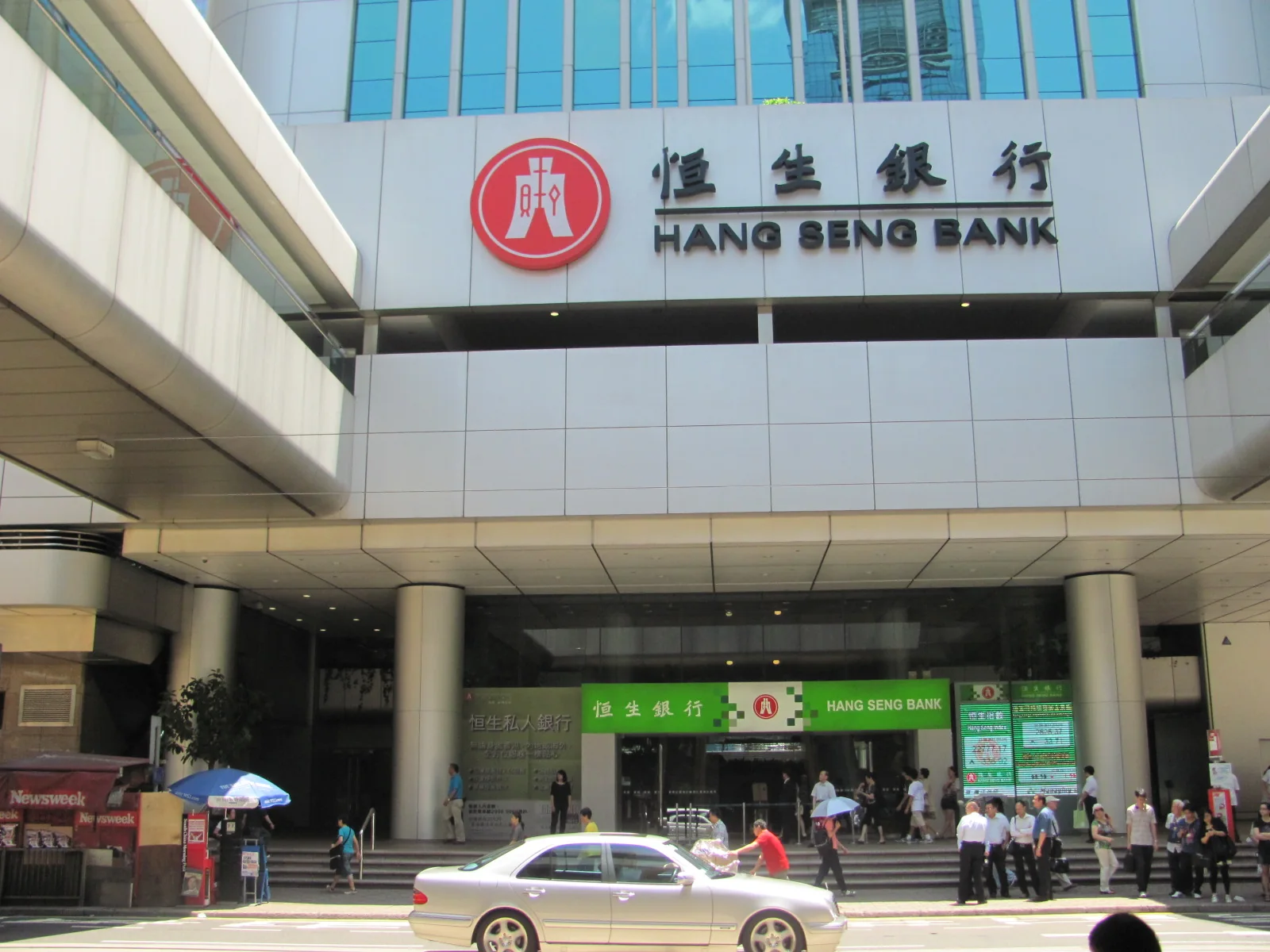
HSBC completed its $13.7 billion privatisation of Hang Seng Bank on 26 January 2026. Hang Seng had already joined the group through a majority investment in 1965. The transaction therefore increased ownership of an existing subsidiary; it did not introduce an entirely new bank to the consolidated group. HSBC stated that Hang Seng would retain its separate banking licence, governance, brand and customer proposition. [1, pp. 3, 8-9; 2]
The strategic logic is to deepen an established anchor while retaining distinct customer relationships. In its February 2026 annual reporting, HSBC expected $0.5 billion of pre-tax revenue and cost synergies by the end of 2028, with $0.6 billion of associated restructuring costs. Those were management expectations, rather than realised benefits. The purchase price creates a corresponding obligation to demonstrate adequate returns from the greater commitment. [1, p. 3]
Choose markets that strengthen useful connections
HSBC's 2025 strategy disclosure specifically identifies mainland China, India, Singapore and the UAE as focus markets because of their connections to international trade, wealth and investment flows. It describes Singapore as its primary wholesale offshore booking centre and wealth hub within ASEAN. The UK provides another substantial domestic customer base alongside Hong Kong. [1, pp. 4, 10]
These roles help explain how a network can become more selective. The bank needs strong places to originate relationships, relevant locations in which to serve them and shared capabilities that join the activity together. It does not need to operate the same range of products in every country. Singapore's role also illustrates why an international network should not be described as a set of spokes serving only Hong Kong. Customers and transactions can originate at several points.
For a Hong Kong client, the value of the wider organisation depends on the services it can deliver where that client actually does business. For the group, geographic breadth earns a strategic role when it improves those connections or supports a strong local franchise on its own merits.
Convert a relationship into useful service at both ends
Consider an illustrative Hong Kong business buying inputs in one market and selling into another. It may need financing before receiving payment, accounts in several currencies, foreign exchange execution and visibility over cash. These are connected tasks. A bank that can coordinate them may reduce the client's administrative effort and execution uncertainty. This example explains the mechanism; it is not a disclosed HSBC customer case.
HSBC's disclosures establish the scale of relevant activity. In 2025, it facilitated around $900 billion of trade, based on internal management information. Bank-wide Wholesale Transaction Banking fee and other income reached $10.9 billion, increasing 4% on a constant-currency basis. These figures show that transaction services are a substantial business. They do not reveal how much activity originated in Hong Kong or how much would disappear without HSBC's international ownership structure. [1, p. 10]
Extend relationships into wealth while controlling their cost
HSBC reported $2.1 trillion of bank-wide wealth balances at year-end 2025, including $1.2 trillion booked in Asia, and $80 billion of net new invested assets during the year. Wealth fee and other income increased 24% on a constant-currency basis to $9.4 billion. [1, p. 10]
Internationally active individuals may value banking and investment services across markets. That creates a potential extension of existing relationships, although eligibility, product availability and regulatory requirements vary by jurisdiction. Wealth balances also include market effects and different product categories. They should not be treated as bank deposits, fresh inflows or revenue.
Figure 2 How local relationships can support a global business
| Stage | Strategic contribution | Condition that must hold |
|---|---|---|
| Local relationships | Access to customers, deposits and knowledge of financial needs | Customers continue to trust and use the local franchise |
| International capabilities | Ability to execute relevant tasks in another market | Licences, systems, people and service capacity remain adequate |
| Coordinated service | Less effort and uncertainty for the customer | The bank actually joins the services together |
| Recurring economics | Revenue and balances that support future investment | Returns cover operating costs, capital and risk |
Source: FU Research analysis. Conceptual mechanism, not an empirical estimate or a claim that every HSBC relationship follows this sequence. The UK is another important relationship base; Hong Kong does not originate all network activity.
Simplify around the connections customers use
Product withdrawal and geographic withdrawal have different effects. On 2 August 2026, HSBC announced an agreement to sell its Egyptian retail banking business while retaining its corporate and institutional banking activities. At announcement, completion was expected in the second half of 2027, subject to regulatory approvals. This was an agreement for a future disposal, rather than an announcement of completion. [5]
The example is consistent with a selective network strategy: retain an international service capability while withdrawing a business with a different customer base and operating model. Whether the retained business remains well supported requires evidence after implementation.
Competitive Advantage Evidence and Counterarguments
Where a defensible advantage may arise
The combination of local relationships and international execution can be difficult to reproduce quickly. A competitor may offer a cheaper payment or a better investment product. Matching the full relationship can require customer access, relevant licences, funding, risk systems and coordinated service in multiple places.
Repeated use may also make HSBC more embedded in a customer's workflows. Moving a single payment can be straightforward; reorganising a set of operating accounts, cash management arrangements and financing facilities can require more work. This is a plausible source of retention, rather than proof of uniformly high switching costs. Customers can maintain several banking relationships and allocate business among providers.
The evidence is therefore strongest for the presence of substantial relevant capabilities and activity. It is weaker for the precise amount of incremental profit caused by their combination.
Counterargument 1 Hong Kong banking economics may explain much of the return
The revenue mix in Figure 1 is a necessary challenge to the thesis. Approximately three-quarters of the Hong Kong segment's revenue came from banking net interest income. Deposit economics, interest rates, hedging and credit outcomes can materially affect returns without demonstrating that international coordination improved.
A sound test should track recurring transaction activity and wealth flows alongside profitability. Even those measures need qualification: wealth balances can rise with markets, and foreign exchange activity can benefit from volatility. Several sources of performance must be separated before assigning the result to strategy. [1, pp. 2, 10, 16]
Counterargument 2 Other banks can make the same strategic claim
Standard Chartered also describes cross-border capabilities and internationally connected wealth services as central to its strategy. Its 2025 annual reporting presents businesses serving corporate, institutional and affluent clients across markets. The broad proposition is therefore shared by a significant competitor. [6]
HSBC's defence must be demonstrated in particular client relationships and market connections. Relevant comparisons include execution reliability, breadth of services actually used and returns after capital and risk. A country count alone cannot distinguish the quality of competing networks.
Counterargument 3 A common brand does not create one unrestricted balance sheet
HSBC's annual report explicitly recognises limits on transferring liquidity between entities. Its group liquidity calculation adjusts for those restrictions. Local deposits cannot be assumed to fund every international opportunity without constraint. [1, p. 161]
Common ownership can support coordination, but the group still operates through legal entities subject to different requirements. This limits the simplest version of the network story: all resources are not freely available everywhere.
Tradeoffs Strategic Implications and Original Insight
Protect the anchor without ignoring concentration
A stronger Hong Kong franchise may improve HSBC's access to valuable relationships. It also increases the importance of local economic conditions. In 2025, HSBC recorded $0.7 billion of expected credit loss charges relating to Hong Kong commercial real estate, compared with $0.1 billion in 2024. Local depth brings exposure as well as opportunity. [1, p. 2]
International reach also introduces operating and compliance costs. HSBC identifies financial crime, fragmented regulation, cross-border data requirements and technology resilience among its risks. Regulatory divergence can make coordination more valuable to clients while making it harder and more expensive for the bank. [1, pp. 30-31]
Distinguish savings from a stronger operating model
During 2025, HSBC actioned approximately $1.2 billion of annualised cost savings from organisational simplification. The in-year reduction in operating expenses was around $0.6 billion, while restructuring and related costs were $1.0 billion. An annualised saving, an in-year expense reduction and a restructuring charge are different quantities; they do not establish a simple cash payback calculation. [1, p. 3]
Lower costs support the strategy when customers retain the capabilities they need. Savings achieved by removing essential service capacity could reduce the value of the remaining network. Profitability at the level of a closing office would miss part of that effect if the lost revenue appeared in another business.
Original Insight The FU Corridor Test
FU Research proposes a practical decision rule: judge an expansion or exit by its effect on the customers and connections that remain across the network.
A corridor means a recurring set of customer needs linking markets, such as financing trade, moving operating cash or managing assets across jurisdictions. The unit of analysis is the customer task and its economics. An office or product contributes value when it helps complete that task at an acceptable cost and risk.
Table 2 Applying the Corridor Test
| Test | Question | Evidence to examine |
|---|---|---|
| Demand | Which customers need this connection and how often? | Active clients, repeat transactions and identifiable unmet needs |
| Completion | Can the bank deliver the required task at both ends? | Account opening, payment reliability, financing availability and service handoffs |
| Economics | What does the connection contribute across the group? | Client revenue, operating balances and returns after capital, compliance costs and expected losses |
| Change | What happens elsewhere if a product or presence is removed? | Retention, service delays, lost mandates and business moving to competitors |
Source: FU Research analytical synthesis. This is a proposed diagnostic, not HSBC's disclosed internal framework or a validated scoring model.
The original proposition is that a local exit can damage value in a business that is not being exited. Management should therefore examine retained clients' ability to complete important tasks before treating a local cost reduction as a successful simplification.
A useful early warning would be longer service handoffs, fewer active connections or recurring mandates moving elsewhere after an exit, even while the remaining local business reports improved margins. That is a testable hypothesis. This research does not establish that HSBC is experiencing those outcomes, and public disclosures do not provide enough detail to score its corridors reliably.
What this adds to FU Research
The Growth–Advantage Framework asks whether the capabilities supporting an advantage can scale. HSBC introduces a related question: can an organisation reduce its footprint while preserving the capabilities its customers depend on? [7]
The Corridor Test extends that inquiry to the effects of simplification across locations and business lines. Its practical implication is to retain complexity where it performs a valuable customer task and remove it where its wider contribution does not justify its cost. General ideas about network economies and connected businesses are established; the contribution claimed here is this FU Research synthesis and decision procedure, rather than universal novelty.
Limitations Conclusion and Research Notes
Limitations and What Could Change This View
HSBC does not disclose a complete matrix of customer flows, service costs and risk-adjusted returns by corridor. Published segment revenue includes internal allocations, and reporting boundaries differ from legal entities and geographic markets. The analysis therefore cannot quantify how much HSBC earns specifically because its local franchises and international businesses share ownership. [1, pp. 304-305]
Company disclosures establish reported activity and management's stated strategy. They do not independently prove superior service, stronger retention or a causal relationship between reorganisation and returns. The conceptual customer example and the Corridor Test should be read as analytical devices.
The thesis would weaken if retained clients consistently used fewer international services despite a stronger Hong Kong franchise, if corridor returns failed to cover capital and operating requirements, or if competitors delivered the same tasks with materially better economics. It would also need revision if repeated simplification programmes produced savings alongside persistent deterioration in execution or customer retention.
Conclusion
HSBC's Hong Kong roots matter because a deep local franchise can give an international bank access to recurring customer needs. The strategic value emerges when capabilities in other markets turn those needs into reliable service and adequate returns.
The evidence supports the relevance of that model, while leaving its incremental economic contribution uncertain. Interest income remains important, local concentration carries risk, and international coordination is costly. HSBC's task is to improve the quality of its connections as it becomes more selective about the activities it operates.
For FU Research, the transferable lesson is to assess each part of a business through the customer relationships and economic activity it enables elsewhere. The Corridor Test makes that principle concrete: follow the task across the network before deciding what to expand, preserve or remove.
Research Notes
- Scope: HSBC Holdings plc and its published group businesses. References to the Hong Kong segment use the FY2025 reporting perimeter, not all HSBC activity in Hong Kong or the full operations of The Hongkong and Shanghai Banking Corporation Limited.
- Currency: US dollars unless another currency is stated. Financial amounts are rounded in prose; Table 1 retains three decimal places in billions to reconcile with the source figures in millions.
- Measures: RoTE means return on average tangible equity. Banking net interest income, constant-currency results, results excluding notable items and target-basis expenses are management-defined alternative performance measures. They are labelled separately from reported results.
- Timing: FY2025 data and the 2026 interim update are presented separately. Subsequent segment re-presentations are not spliced into the FY2025 table. Announced transactions are distinguished from completed transactions.
- Calculations: Figure 1 uses 12,082 ÷ 15,878 and 3,796 ÷ 15,878, rounded to one decimal place. Trade activity, deposit shares, wealth balances and invested-asset flows have different definitions and are not combined into a network market-share estimate.
- Interpretation: The Corridor Test and the proposed early warning indicators are FU Research analysis. No corridor score, proprietary customer experience or undisclosed HSBC internal policy is asserted.
- Purpose: Business strategy research. This article does not provide a valuation or a recommendation to buy or sell HSBC securities.
Revision History
| Version | Date | Description |
|---|---|---|
| 1.0 | 18 October 2026 | Initial research manuscript with FY2025 financial evidence, a 2026 interim update and the FU Corridor Test |
References
- [1]
HSBC Holdings plc. Annual Report and Accounts 2025. 25 February 2026. Relevant printed pages: 2-4, 8-10, 13, 16, 30-31, 161 and 304-305. Page references use the report's printed pagination, not the PDF reader's page count. https://www.hsbc.com/-/files/hsbc/investors/hsbc-results/2025/annual/pdfs/hsbc-holdings-plc/260225-annual-report-and-accounts-2025.pdf?download=1
- [2]
HSBC. History timeline. Founding in Hong Kong and Shanghai, the first London office, subsequent expansion and the 1965 majority investment in Hang Seng Bank. Accessed 18 October 2026. https://www.hsbc.com/who-we-are/our-strategy-and-values/our-history/history-timeline
- [3]
Hong Kong Monetary Authority. Annual Report 2025, International Financial Centre chapter, especially printed p. 122. Accessed 18 October 2026. https://www.hkma.gov.hk/media/eng/publication-and-research/annual-report/2025/16_International_Financial_Centre.pdf
- [4]
HSBC Holdings plc. Interim Results 2026 media release. 4 August 2026, p. 1. https://www.hsbc.com/-/files/hsbc/investors/hsbc-results/2026/interim/pdfs/hsbc-holdings-plc/260804-hsbc-holdings-plc-interim-results-2026-media-release.pdf
- [5]
HSBC. HSBC agrees to sell Egypt retail banking business to Emirates NBD. 2 August 2026. Includes the transaction timetable, retained corporate and institutional activities and parent-company headquarters. https://www.hsbc.com/news-and-views/news/media-releases/2026/hsbc-agrees-to-sell-egypt-retail-banking-business-to-emirates-nbd
- [6]
Standard Chartered. Annual Report 2025, business descriptions and strategy overview. Accessed 18 October 2026. Used to establish that cross-border corporate banking and international wealth are also competitor propositions. https://www.sc.com/en/investors/financial-results/annual-report
- [7]
FU Research. When Growth Weakens Competitive Advantage. 16 August 2026, updated 23 August 2026. https://furesearch.com/strategy/when-growth-weakens-competitive-advantages